Let us help you grow the business you love.
Your world is about to get a whole lot simpler.


Community management is, at its core, a strategic role. It exists to guide governance, protect asset value, reduce risk, and ensure communities operate efficiently and sustainably.
But in practice, that’s not how the role is being experienced.
Instead, a significant portion of a community manager’s time is spent responding to emails, following up on requests, clarifying decisions, and chasing approvals.
This matters – not only because it makes administration the most visible element of the community manager’s service, but also because it actively pulls focus away from the areas that truly create value: compliance, financial oversight, and long-term community performance.
Industry data shows that nearly half of a community manager’s time is spent on communication, with requests, queries, and follow-ups accounting for approximately 44.4% of total effort.
This communication doesn’t come from a single source. Trustees, owners, internal teams, and service providers all contribute to a constant flow of requests, each requiring attention, context, and response. Financial queries, maintenance issues, approvals, compliance updates, and more – all arriving through different channels, often at the same time.
And, as the ENGAGE 2026 panellists pointed out, the real workload isn’t even the request itself. It’s everything that happens after it.
Each interaction triggers a chain of actions:
And when these interactions are spread across emails, WhatsApps, phone calls, and meetings, they become difficult to track, manage, and resolve efficiently. The result is a working environment defined by constant interruption, where progress hinges not on skill or professional insight, but on how effectively communication is managed in the moment.
This raises an important question: Why has communication become such a dominant force in the first place?
To understand this, we need to look at how the system itself is structured.
At the centre of every community scheme is a trustee-led governance model. One that places decision-making responsibility in the hands of individuals who are typically not full-time professionals.
As Marina Constas, Director at BBM Law, highlighted during the ENGAGE 2026 panel discussion, community schemes today operate far beyond their original scope. They function as complex financial and operational environments, with significant legal and fiduciary responsibilities.
And yet, the people tasked with making critical decisions within these environments are often volunteers, balancing these responsibilities alongside their own careers and personal commitments.
As result, decisions take time, approvals are delayed, uncertainty grows, and – inevitably – communication increases. Follow-ups become necessary, clarifications are requested, additional information needs to be gathered.
What emerges is what Constas described as “governance paralysis” – a situation where progress slows not because work isn’t being done, but because decisions are difficult to make and even harder to finalise.
In this environment, the role of the community manager inevitably begins to shift. Instead of operating as strategic advisors and asset managers, they are pulled into the role of facilitator, coordinator, and, often, persistent follow-up.
If communication is where so much time is being lost, the instinctive response is to try to improve it – faster replies, clearer messaging, better organisation.
But the real limitation isn’t how communication is managed. It’s what communication is being asked to do.
In community management, many of the most important activities – handling maintenance, resolving financial queries, securing approvals – are not conversations. They are structured processes, with multiple steps, stakeholders, and dependencies.
And processes don’t perform well when they are managed through conversation.
When workflows are replaced by communication, the burden shifts to the individual. The community manager becomes responsible not just for the task itself, but for remembering, tracking, coordinating, and driving it to completion.
And that’s where the system begins to break down – because conversations can start work, but they can’t carry it to completion.
This is where technology begins to play a defining role. Not as a replacement for people, but as an enabler of better ways of working.
As independent economist, John Loos, highlighted during the ENGAGE 2026 panel discussion, the real risk facing industries today isn’t technological advancement – it’s failing to adapt to it.
In community management, the opportunity is clear.
Many of the activities that consume the majority of time – repetitive communication, manual follow-ups, administrative coordination – are exactly the types of tasks that technology can handle more efficiently, more consistently, and with far greater visibility.
When these tasks are structured and supported by the right systems, something important happens:
Time is returned to the professional.
Time to focus on financial oversight, guide governance decisions, proactively manage risk and performance. In other words, time to operate at the level the role was always intended to deliver.
If technology enables this shift, the next question becomes practical:
What does communication look like when it’s properly supported by the right technology?
Within a connected ecosystem, communication is no longer something that sits outside the work. It becomes part of it – embedded within structured, shared workflows where every request, action, and decision has a clear place, a clear owner, and a visible path to completion.
In this environment, communication doesn’t disappear – it becomes purposeful.
And, importantly, responsibility is no longer carried by one person.
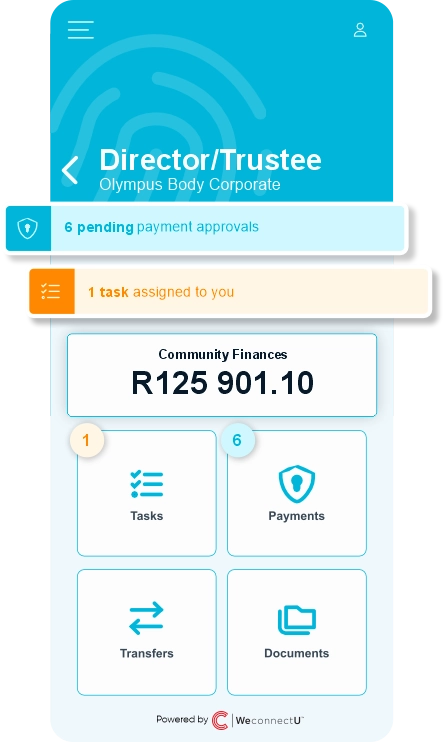
Trustees, owners, and stakeholders become part of the workflow itself – able to view, respond, and make decisions within a structured process, with the information they need at their fingertips to make informed decisions, rather than relying on disconnected messages.
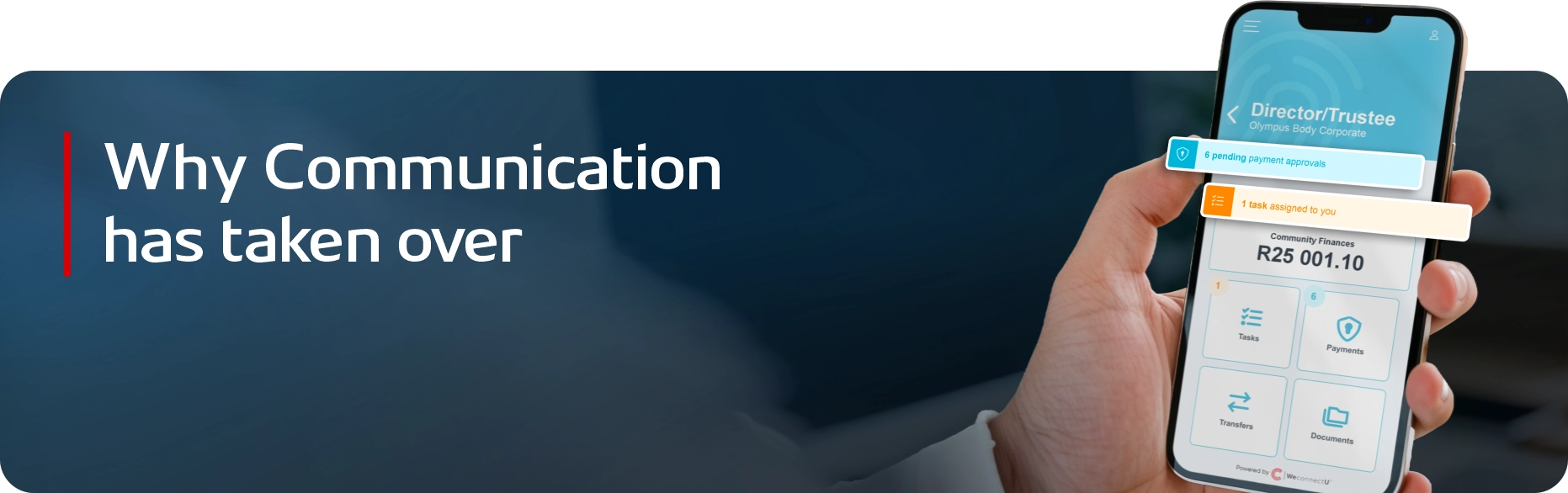
This is the thinking behind the WeconnectU ecosystem, and the evolution of that vision is reflected in our Community App. It brings trustees, owners, and stakeholders directly into the workflow, instead of relying on communication to bridge the gap.
The result is clearer, more purposeful communication, faster decisions, and community managers that finally have the time to focus on what really counts.
As focus shifts from juggling communication to guiding governance, strengthening financial oversight, reducing risk, and improving long-term community performance, the true value of the community manager finally becomes visible.
It is no longer defined by responsiveness or the volume of communication, but by the quality of decisions, the strength of governance, and the outcomes delivered.
Communities run more effectively, decisions are made with greater clarity, and financial performance becomes more predictable and resilient.
The role of the community manager transforms from reactive coordinator to strategic leader.
This is how the industry moves forward – towards a more professional and sustainable future, where community managers are not only delivering value, but are recognised for it.
Because ultimately, this is what happens when the communication roadblock is removed: the role is no longer defined by managing communication, but by leading performance.
Ready to see what happens when communication stops holding you back?