Let us help you grow the business you love.
Your world is about to get a whole lot simpler.



Ask most rental professionals what they do, and you'll get a familiar list: place good tenants, collect the rent, run inspections, keep leases current, coordinate maintenance. It's an honest answer, and it describes a real day's work. But it also describes activity – not impact.
That distinction is quickly becoming the most important one in the industry.
Why? Because the investor on the other side of that work isn't paying for tasks to be completed. They're paying for an outcome: income they can rely on, risk that stays contained, an asset that grows rather than slowly erodes.
The interesting thing is that the same activities can sit on either side of that line. The work itself looks identical – what changes is the intent behind it.
Which raises a question worth sitting with: Am I managing tasks, or am I managing value? Increasingly, how you answer it shapes how relevant – and how well paid – you are.
It helps to picture the work as an iceberg. Above the waterline sits everything visible: the inspection logged, the rent reconciled, the lease renewed on time. That's the part the investor sees, and it's the part that's easy to mistake for the whole job.
But the part that actually protects their investment sits below the surface. Each of those visible tasks is really in service of something larger – optimising income, containing risk, preserving the asset's condition, attracting and keeping better tenants, and keeping the investor genuinely in the loop. That's the growth equation, and it's where a portfolio's long-term value is won or lost.
None of this asks you to do different work. It asks you to see the work differently. Collecting the rent isn't really an admin task at all – it's how you protect an income stream someone is relying on. Run an inspection with that lens and you're not just going through the motions; you're catching the small problem before it becomes the expensive one. The task stays the same. What changes is your handle on why it matters.

It would be easy to read all of this as a mindset exercise – a nicer way to describe the same old job. What makes it more than that is that the expectations of the role itself have started to shift, and compliance is where you can see that most clearly.
Compliance has long been treated as pure paperwork: fiddly, repetitive, a great deal of effort for very little in the way of tangible results. If anything was ever safe to treat as a box-tick, surely it was this. But the Financial Intelligence Centre has sharpened its enforcement considerably, with reported penalties against individuals reaching as high as R7.8 million, and a clear willingness to act where a compliance programme exists on paper but not in practice.
An agency's Fidelity Fund Certificate – without which it cannot legally trade – really does now hinge on proving, on demand, that the work was genuinely done. So, the safest box-tick on the list has become risk mitigation of the most fundamental kind.
A current, provable compliance record doesn't just keep the regulator satisfied; it protects the investor's asset and the agency's licence to manage it.
In other words, the task hasn't changed, but the world has raised the stakes and, in doing so, revealed what the task was worth all along.
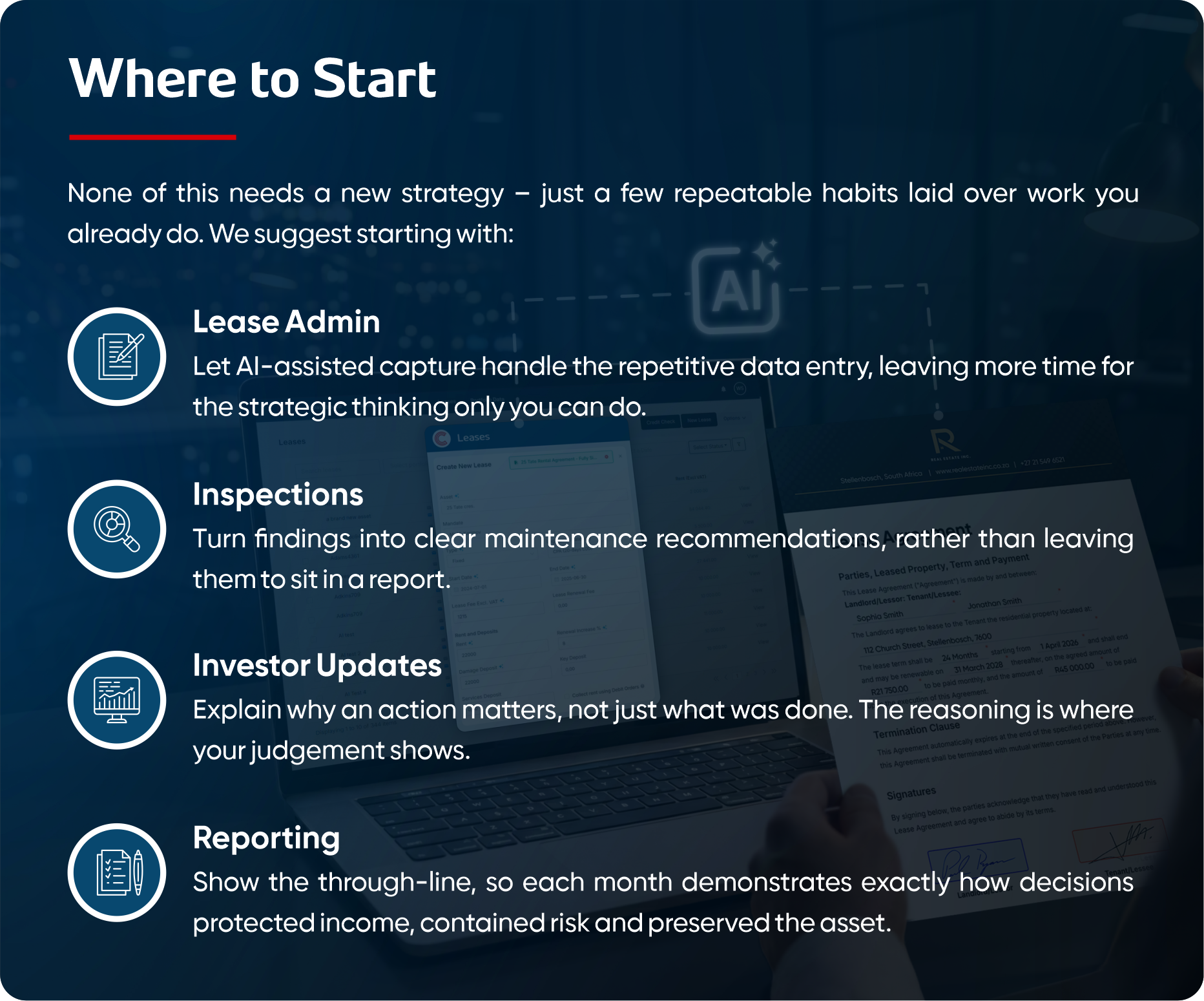
If this sounds a little overwhelming, here's the reassuring part: change isn't built on grand gestures. It's built on habits. And the place it takes hold is refreshingly ordinary: what you do on a Tuesday afternoon, repeated until it's simply how the team works.
The behavioural research is consistent on what makes a habit stick: do it regularly, attach it to a fixed trigger (so it isn't left to memory), keep the action small enough that it's never the thing you skip when you're busy, and build in a payoff you can feel early.
Get those right and the action more or less repeats itself.
And the good news is that every small, consistent action compounds. A modest improvement in how you handle one recurring task, repeated across a portfolio and across a year, adds up to a materially better-managed asset – and a noticeably stronger case for the fee attached to it.
So, let’s return to the question this all started with: are you managing tasks, or managing value? The real answer is that these were always two sides of the same coin.
The same inspection, the same renewal, the same compliance record can be filed and forgotten, or it can be the visible proof that someone is actively protecting an investment. The work is identical. Only the intent, and the way it's understood, differs.
That's what separates a rental administrator from a rental asset manager – not a new job title or a bigger team, but a clearer line of sight from each task to the investor outcome behind it. It's the most achievable kind of professional growth there is, because it asks you to start by changing how you see the work you're already doing.
It’s why the rental professionals who lead the next decade won't be the ones doing dramatically more. They'll be the ones who turn everyday tasks into consistent habits that protect income, reduce risk, and grow the value of every investor's asset.
Discover how WeconnectU helps you turn everyday workflows into lasting investor value.