Let us help you grow the business you love.
Your world is about to get a whole lot simpler.



Compliance used to sit in the background of a property business. Financial Intelligence Centre Act (FICA) obligations would be met, but rarely revisited, and certainly never considered a selling point.
That era has ended.
The Financial Intelligence Centre has officially made the shift from education to enforcement, and the industry commentary is blunt: the grace period is over. A recent ruling made it crystal clear that compliance on paper is no longer enough. Regulators want proof that it works in practice, with the records, timestamps and audit trail to show it. The bar has been raised, and it now extends to the Fidelity Fund Certificate that underpins an agency's ability to operate.
The question is no longer whether your compliance exists. It is whether you can show it.
Let’s face it: compliance has never been exciting. It’s detailed, repetitive, and time-consuming, with little to show for the effort it takes.
Thankfully, regulators aren’t asking for more effort. They’re asking for more evidence.
The reality is that a manager can vet every tenant, screen every transaction and follow every procedure correctly, and still fail a compliance inspection if none of that can be proven, in order and on demand. The work and the proof of the work have become two separate requirements, and only one of them counts to the inspector.
That distinction may sound technical, but it actually reframes the whole task. Compliance is no longer about checking the right boxes. It’s about proving due diligence.
And that is a more useful standard than it first appears…
Here’s where things get interesting. The record that satisfies an inspector is the same record that reassures a client.
An investor wants to know their asset is protected and their obligations are being met. A trustee wants that same confidence on behalf of their community. Until now, much of that reassurance has rested on trust alone, because the underlying work was hard to see.
A demonstrable compliance trail changes that, letting a property manager show – with evidence rather than assurance – that risk is being managed and obligations kept current.
That is what turns compliance from a cost into a credential. The manager who can produce the proof is not only covered when an inspector calls; they are better placed to earn the confidence of the people whose assets are in their care.
Of course, a demonstrable trail is not a matter of diligence alone. It depends on whether the systems behind the work are built to capture it. It’s impossible for scattered tools and manual records to produce a clear answer the moment one is asked for. But an end-to-end ecosystem like WeconnectU is a different story.
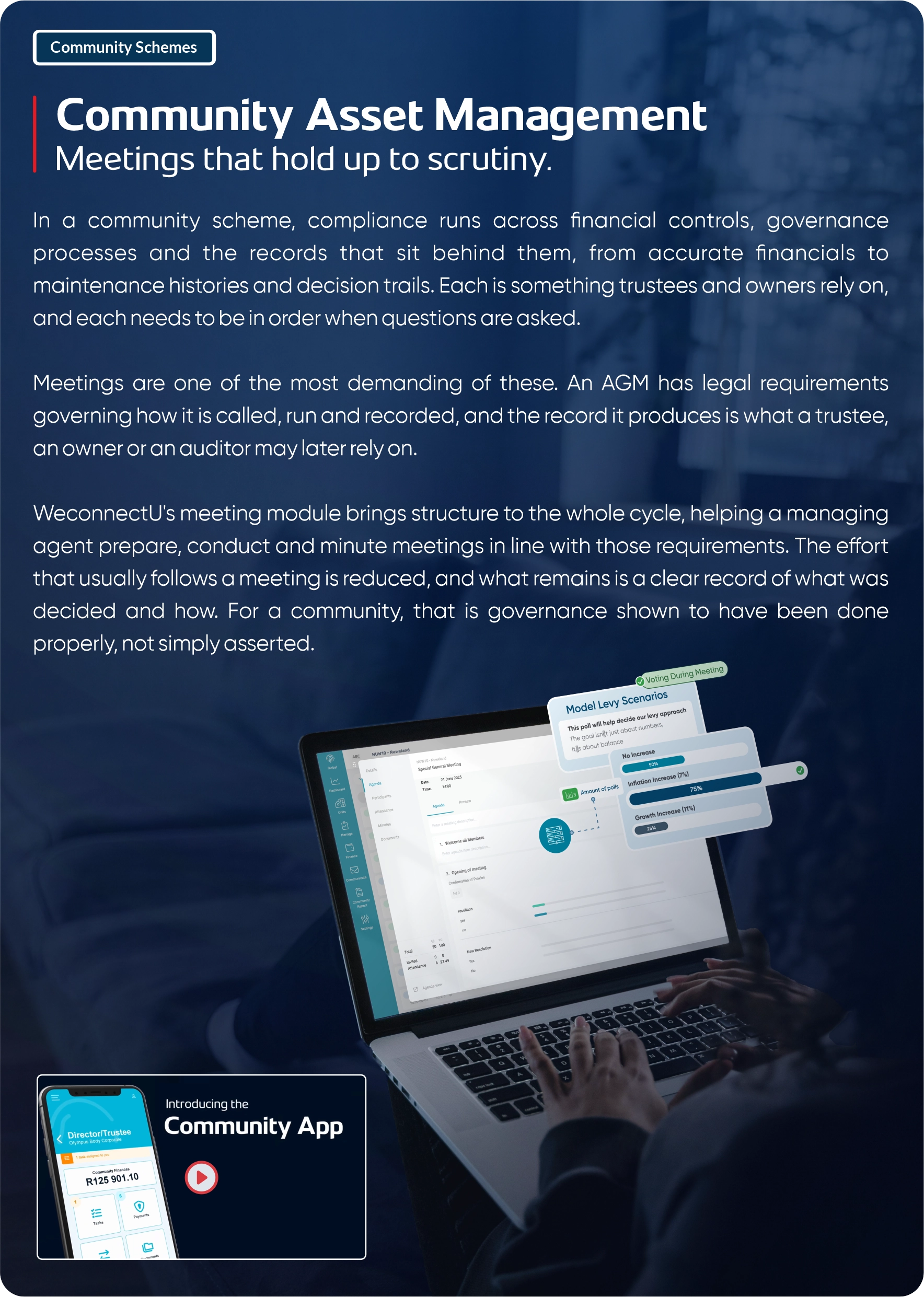
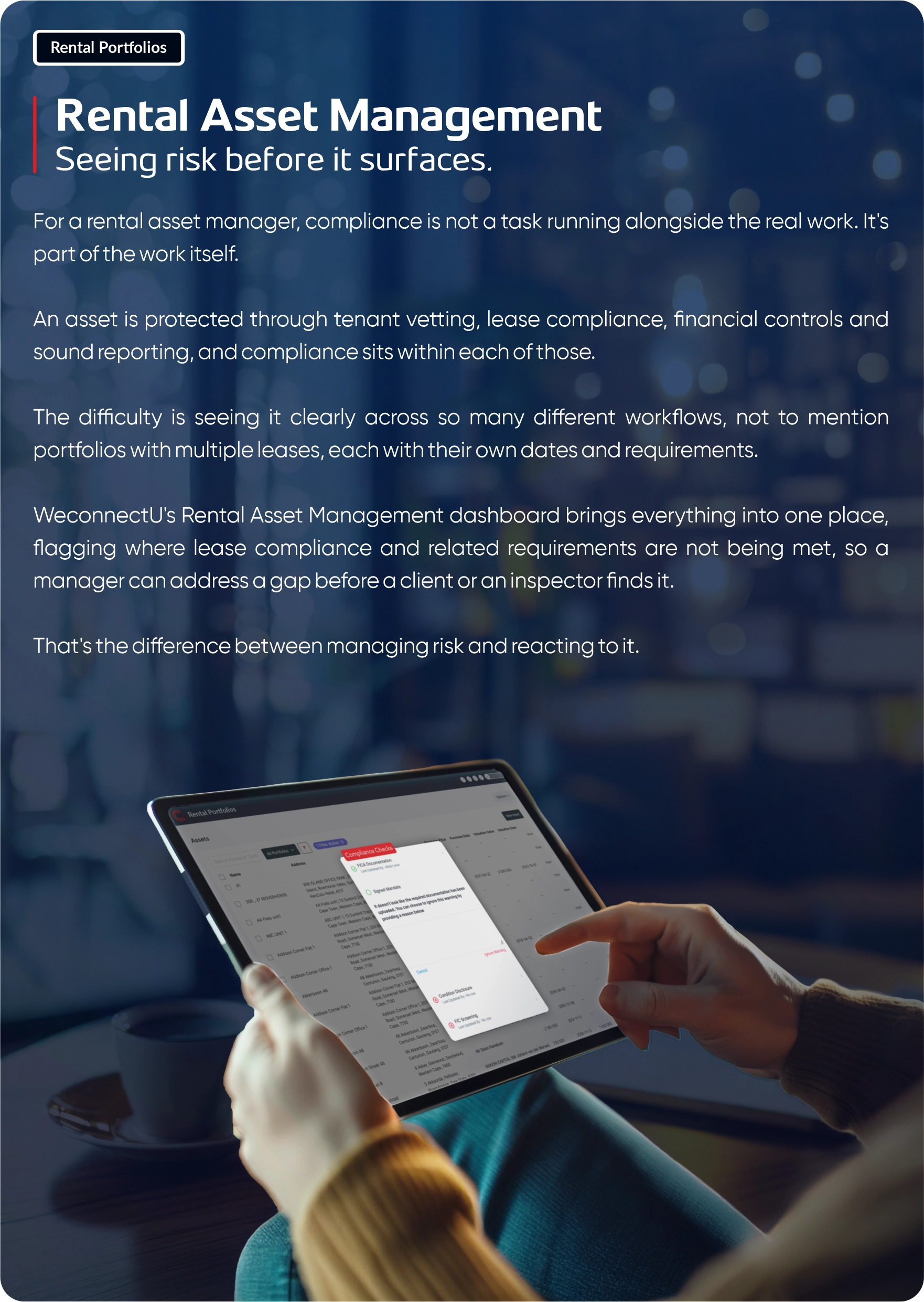
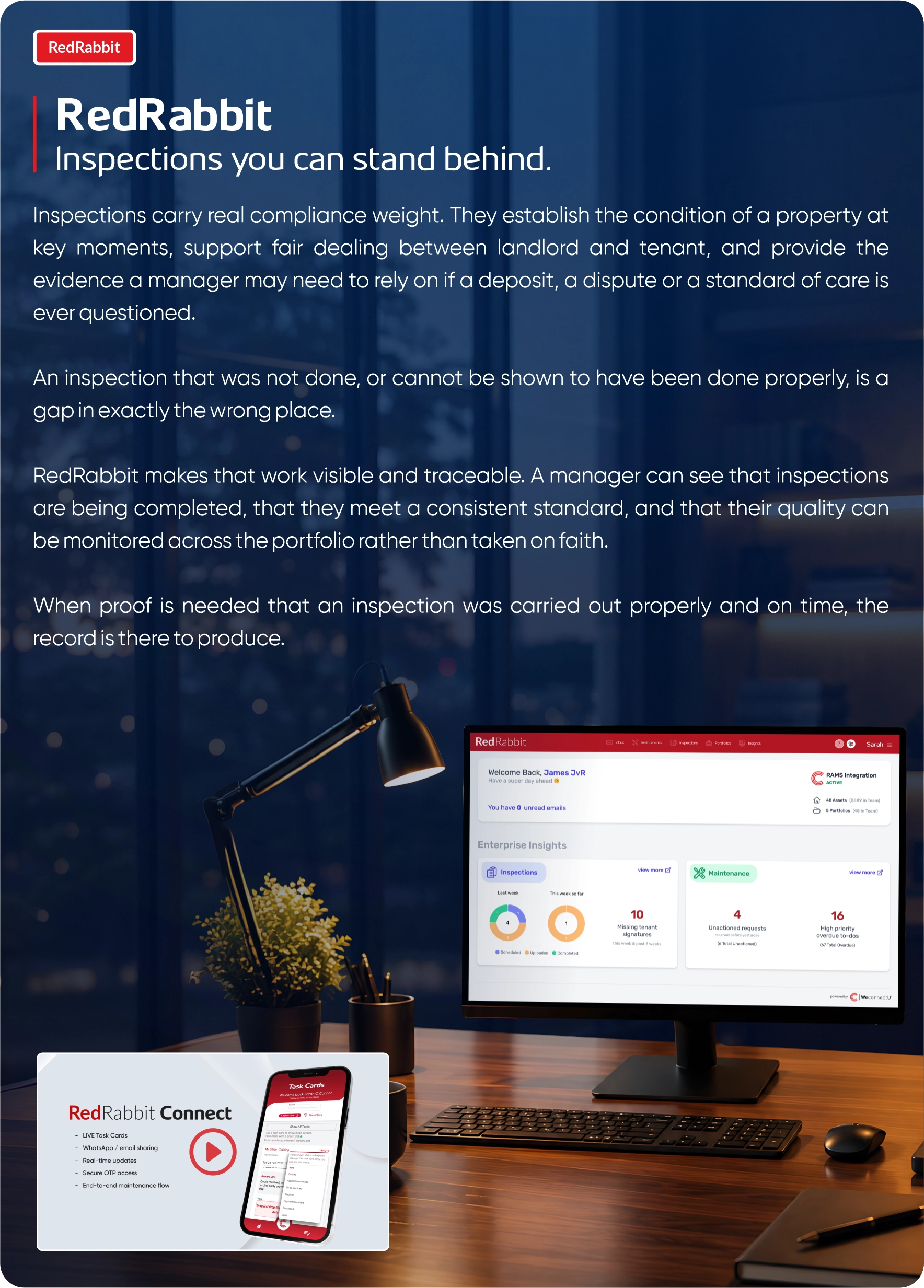
Each of those solutions is useful on its own. What makes the difference for compliance is that they work as one.
Compliance rarely sits in a single place. It runs across leases, financials, meetings, inspections and the records behind all of them, and the moment those live in separate, disconnected tools, the trail breaks. Producing a clear answer means stitching it back together by hand, usually under pressure and usually too late.
When the whole business runs on one connected platform, that trail stays intact by default. Information is captured as the work happens, held in order and ready to be produced when a client asks or an inspector calls.
The proof is a by-product of working properly, rather than a scramble after the fact.
Compliance is complicated, with increasingly little room for error. But the same shift that raises the bar also creates an opening.
A property manager who can produce the proof is not just protected when scrutiny comes. They can show a client, plainly, that the asset is being managed with care and the obligations kept in order.
That’s no longer invisible back-office work. It’s a visible mark of a professional who can be trusted with what matters most.
This was always part of how WeconnectU understood the job. From the start, compliance sat among the core challenges our solutions were built to solve – alongside manageability, scalability and profitability. The only thing that’s changed is how much compliance counts, and how much there is to gain from getting it right.