Let us help you grow the business you love.
Your world is about to get a whole lot simpler.

The role of a trustee in community schemes has changed significantly over the past decade.
Following the regulatory changes in 2018, the demands placed on managing agents increased, but so too did the fiduciary responsibility carried by trustees. What was once considered a voluntary oversight role has evolved into one of the most important governance functions within residential communities.
Trustees today carry real accountability. They oversee financial performance, approve supplier payments, monitor compliance, guide key decisions, and ultimately safeguard the value of shared assets.
This responsibility matters because the health of a community scheme is not measured only by its physical appearance. It is reflected in financial stability, compliance, maintenance standards, and the long-term value of the properties within it.
Yet most trustees fulfil this role alongside careers, families and personal commitments. They are not full-time operators. They are custodians of shared assets, entrusted with decisions that affect entire communities.
And while expectations have increased, the way governance happens in many schemes has not evolved at the same pace.
This is where the pressure begins.
There is already a noticeable decline in the willingness of owners to take on the role of trustee.

Community schemes operate within a regulatory framework where managing agents are required to seek instruction or approval before acting on certain matters. While this ensures accountability, it often introduces friction.
In practice, decisions unfold through long email threads, scattered attachments and multiple messaging platforms. A request is sent, forwarded, clarified, and revisited. Documents are shared repeatedly. Context is lost. The process slows.
What starts as a small delay rarely remains small.
Supplier payments are postponed. Maintenance work waits for approval. Compliance deadlines move closer. Community managers carry growing operational pressure without the structure to move decisions forward efficiently.
Communities, however, do not slow down simply because decisions do.
Buildings still require maintenance. Contractors still expect payment. Residents still expect a well-managed environment. When governance slows, operational momentum slows with it.
The cost is not only financial. It is also relational.
Fragmented communication makes transparency harder to maintain. Limited visibility weakens trust between stakeholders. Community managers feel pressure from residents and contractors, while trustees feel pressure from managers. Over time, a gap begins to form between the work being done and the value being perceived.
Often, the problem is not effort. It is structure.
Trustees play a critical role in community governance. Their responsibility is not symbolic. It is fundamental.
But oversight was never designed to operate through fragmented communication.
Email inboxes were built for correspondence, not governance. Messaging platforms were built for convenience, not structured decision-making. When governance depends on these tools alone, it becomes reactive by nature.
Information becomes difficult to track. Decisions are harder to verify. Documents are repeatedly shared. Clarity depends on individuals remembering context rather than systems providing it.
The issue is not trustee involvement.
It is the environment in which that involvement takes place.
Even well-intentioned decision-making becomes slow and cumbersome when it is managed through inbox threads and messaging platforms.
Communities deserve better than that.
Across the property management industry, a shift is beginning to emerge. Governance is moving away from reactive communication toward structured workflows that enable clear and efficient collaboration.
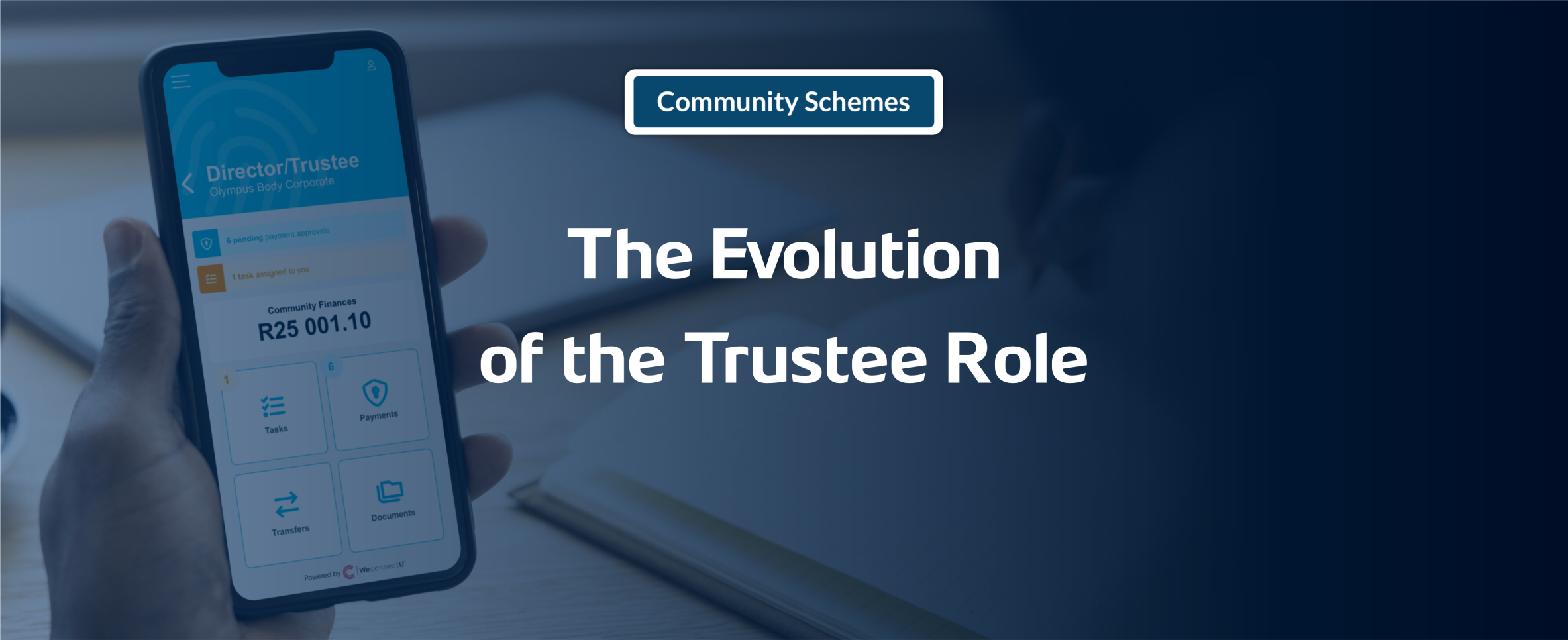
Decision and visibility platforms are bringing trustees directly into the management workflow. Instead of searching for information, trustees are presented with it in context. They can see supporting documents, understand financial implications and track approvals without navigating multiple channels.
This changes the dynamic entirely.
Decision cycles become shorter. Supplier relationships improve as approvals and payments move faster. Compliance becomes easier to manage because deadlines and documentation are visible. Communication reduces because information is centralised rather than repeated.
Most importantly, trust improves. When decisions are visible and processes are clear, the perception gap begins to close.
Governance becomes lighter without becoming smaller.

This shift is part of a broader transformation across the property management sector.
Community schemes are increasingly complex environments that require financial oversight, operational coordination and long-term asset protection. As a result, community managers are moving beyond administration into the role of community asset managers.
As this evolution takes place, the structures surrounding community schemes must evolve as well.
Community managers are stepping into asset management roles. Trustees are moving from inbox oversight to structured governance partners.
This is not about working harder. It is about improving collaboration in a way that enables better decision-making.
The responsibilities placed on trustees are unlikely to decrease. Regulation is increasing. Financial scrutiny is growing. Expectations from residents continue to rise.
Trustees want to fulfil a role that carries responsibility without it becoming unmanageable. They need clear financial reporting, convenient access to information and the ability to engage with a professional and transparent community manager.
Creating structured ways of working is no longer optional. It is essential.
When trustees are brought into a centralised workflow, data remains accurate, live and accessible. This creates the foundation for technology to support much of the effort currently carried by trustees and community managers.
And when collaboration functions effectively, communities benefit.
They become more compliant, more manageable, more scalable and ultimately more financially stable.
The trustee role has evolved significantly.
Now the systems, workflows and ways of working that support that role must evolve with it.