Let us help you grow the business you love.
Your world is about to get a whole lot simpler.

Here’s an uncomfortable truth that quietly shapes every property management business: people don’t pay for the value you deliver. They pay for the value they can see. You can be the most diligent, technically sound, deeply experienced manager in your market, and still find yourself competing on price – because the work you do behind the scenes stays exactly there. Behind the scenes.
Most property managers feel this friction every time an investor questions a fee, every time a renewal slides into a renegotiation. The instinct is to work harder and prove the worth, but effort alone rarely closes the gap. What closes it is communicating your value in the language your investor actually speaks – not the how of your work, but the what it achieves for their asset.
One of the most underused tools for doing exactly that is sitting right there in your operational calendar.
Mid-term inspections have long carried a reputation for being compliance work – something you schedule, complete, file, and move past. That framing badly underestimates what they actually are.
Walk into a property halfway through a tenancy and you are gathering, in a single visit, a remarkably rich set of signals: how the tenant is treating the home, what maintenance is creeping up, where small issues are quietly becoming expensive ones, and where the asset’s performance could be lifted. That is not administration. That is intelligence – the kind investors don’t usually have access to, and the kind that genuinely affects long-term yield.
The inspection itself isn’t where the value lives. The value lives in what you do with what you find.
We saw something interesting at a recent event. When we asked who was conducting mid-term inspections, 185 hands went up; 66 didn’t. That’s a noticeable jump from the same question a year earlier, when adoption sat closer to half the room. The direction of travel is unmistakable, but the more telling number is the quarter of the industry still leaving this opportunity untouched.
Historically, the sticking point was friction: the time, the paperwork, the effort of producing something polished afterwards. Now, tools like RedRabbit have stripped the operational drag out of the process.
Open the original ingoing report on your phone, take comparison photos as you walk, and a clean, presentable report assembles itself in seconds. The practical reason to avoid mid-term inspections has quietly evaporated. What’s left is the question of how you choose to use them.
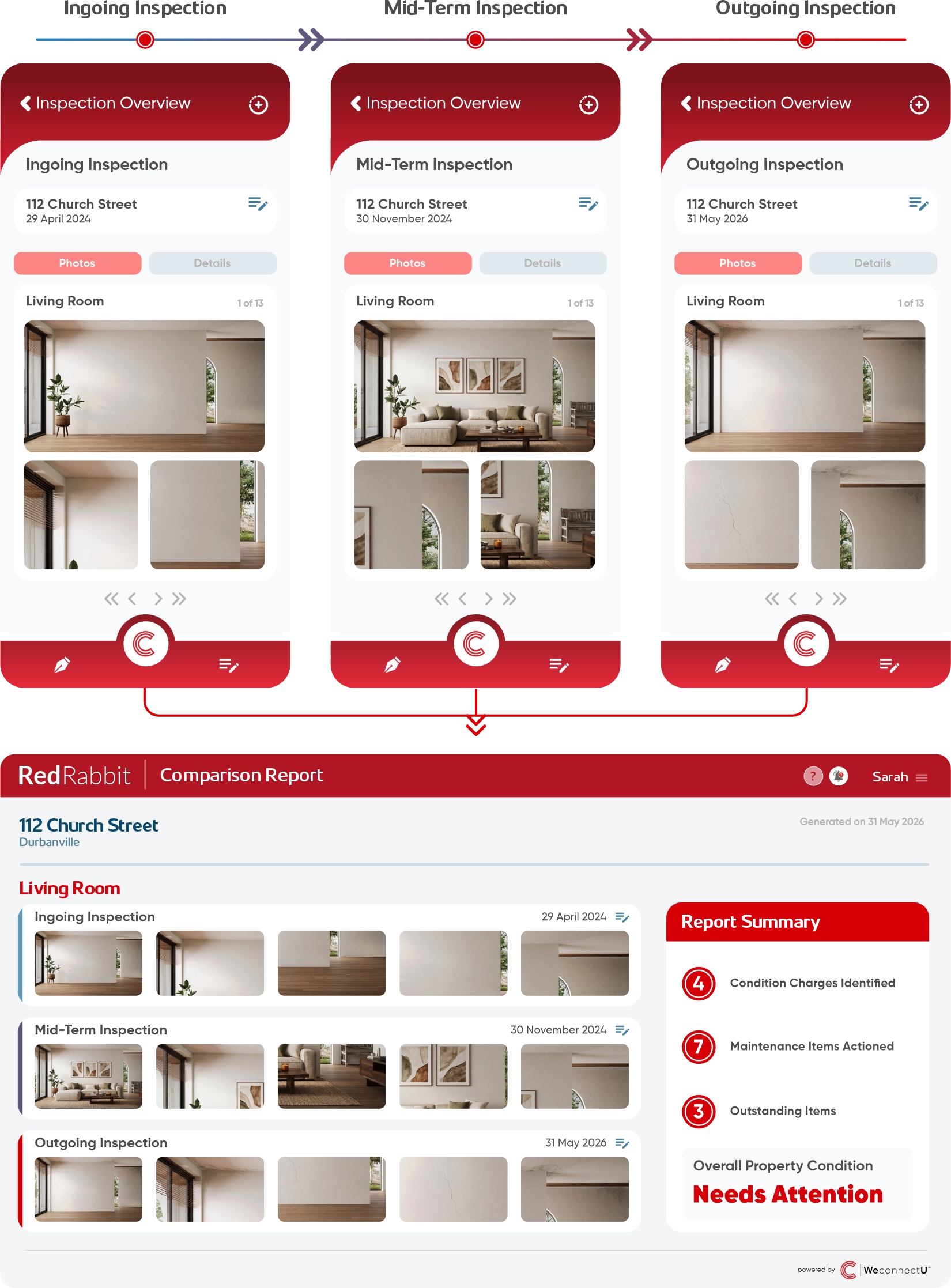
Once a report exists, the temptation is to email it to the investor and feel the job is done. It isn’t. A report on its own is information; an investor wants insight.
A photo of a damp patch tells them something happened. A short conversation about what caused it, what it could have cost left another six months, and what you’ve already actioned – that tells them you’re managing their asset, not just looking at it.
This is the move that separates property managers from asset managers, and it tends to take the form of two very specific conversations.
This one happens off the back of the inspection itself, while the detail is fresh. Its job is to turn observation into strategy. You walk the investor through the maintenance items worth pre-empting now to avoid larger spend later; the small upgrades that would lift rental potential at the next renewal; and the tenant behaviours that suggest a long, stable stay – or the early warning signs that suggest the opposite.
Done with care, this positions you as the person actively protecting and improving the asset, rather than the person simply reporting on its condition.
The second conversation is lighter, less formal, and arguably more powerful. A quarterly call, a short message with a snapshot of how things are going, a quick note flagging something you noticed and have already handled. Investors notice silence – when months pass with no contact, they fill the gap with assumptions, usually unflattering ones. A brief, proactive check-in pre-empts all of that. It costs almost nothing in time and pays back disproportionately in trust.
The reality is that every investor relationship is shaped by a handful of pivotal moments – the points at which the investor, often unconsciously, decides whether you are worth what they pay you.
The shape of these moments is remarkably consistent. It’s the message that flags a risk before it becomes a claim. It’s the recommendation that nudges yield upward at the next renewal. It’s the forward-looking note that anticipates what they’ll want to know next quarter, before they’ve thought to ask.
None of these require heroic effort; they just require the choice to communicate what you already know.
A wow moment isn’t about doing more. It’s about letting the investor see what you’re already doing.
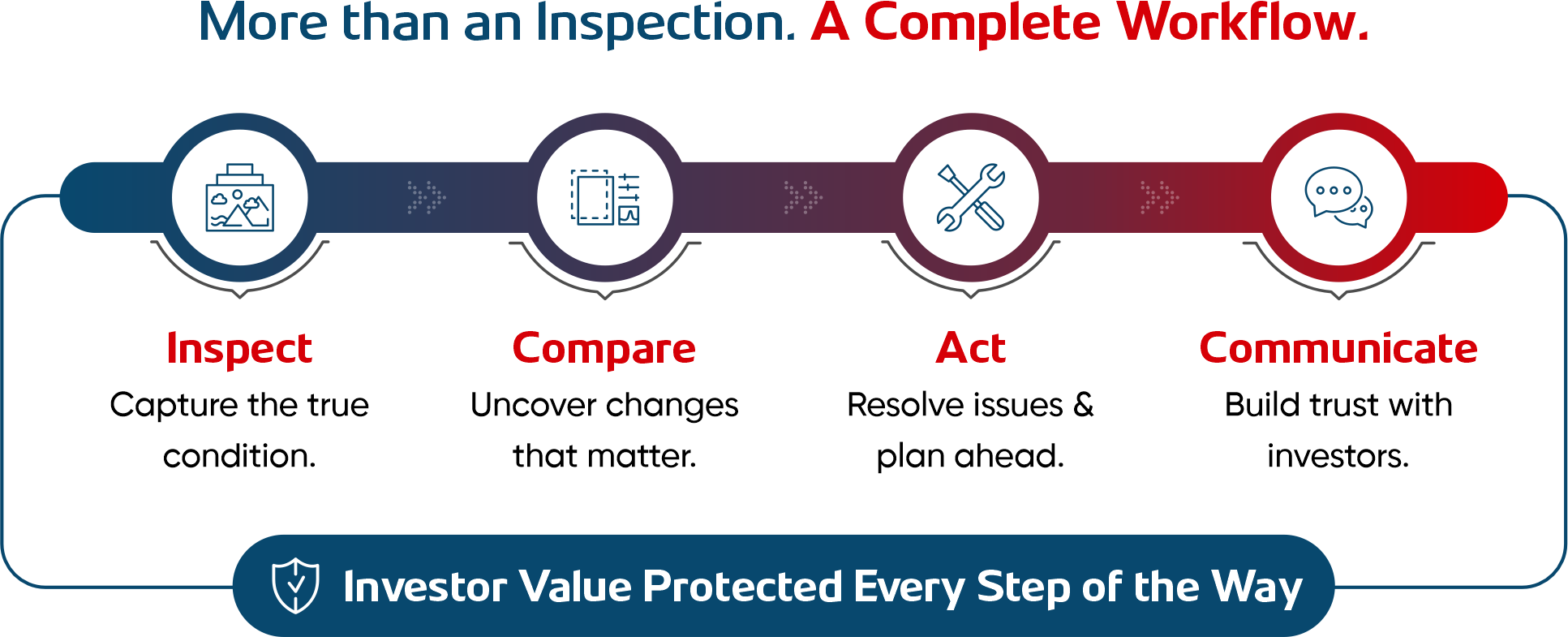
The firms growing fastest, retaining best, and commanding the strongest fees are not doing fundamentally different work. They have stopped describing themselves as administrators of property and started behaving as stewards of investment. Mid-term inspections are one of the most accessible places to make this shift visible – they give you a structured, repeatable, technology-enabled reason to show up with information that matters, frame it strategically, and reinforce that the asset is in genuinely capable hands.
You don’t need a new service offering or a new fee structure. You need to use what’s already on your calendar with intent.
The gap between an average property manager and a trusted asset manager is rarely a gap in competence. It’s a gap in communication – in the willingness to translate good work into something the investor can see, feel, and measure.
You are almost certainly already delivering more value than your investors realise. The opportunity isn’t to do more. It’s to let them see what’s already there, and to be paid, properly, for the work you’re already doing well.
And with the right tools, that shift becomes not only possible, but repeatable. RedRabbit is designed to help you bring your work to the surface—turning inspections into clear, professional insights that position you as the steward of your investor’s asset. If you’d like to explore how these features can support you in becoming more valued and valuable in every interaction, we invite you to connect with us.